
Lake County Criminal Court Cases
Lake County divides criminal case work between General Sessions and the Circuit or Criminal Court of Tennessee's 29th Judicial District. General Sessions handles warrants, initial appearances, misdemeanor trials, and preliminary hearings in felony matters. A felony that proceeds may be sent to the grand jury. A returned indictment then places the filed counts before Circuit or Criminal Court. Municipal courts have limited ordinance and traffic authority under local law, but they do not try felony charges.
The Circuit Court Clerk is the custodian for the core Lake County criminal case file. The office keeps criminal minutes, docket events, post-conviction matters, grand-jury reports, appeals, fines, costs, and restitution records. The county's Circuit Court page identifies that work and provides selected public documents from a high-interest matter. That selective publication does not amount to a general online docket. The clerk remains the main route for a name search, case status, inspection, or copy.
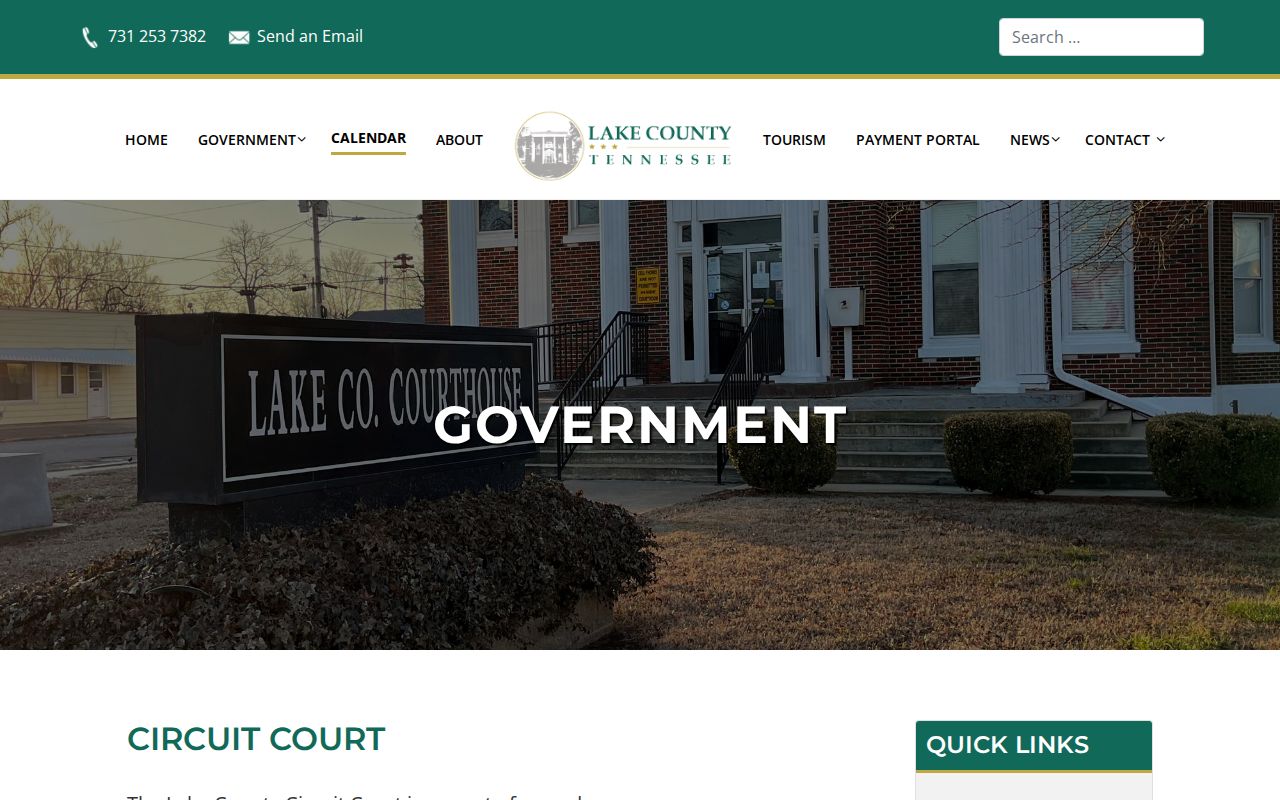
The captured Circuit Court page helps identify the right Lake County office, while the clerk's own file supplies the controlling docket and judgment.
Lake County Court Jurisdiction Split
A search can stall when the requester asks only for a “criminal case” without naming its stage. A complaint may first appear in General Sessions. There, the court can address release, a preliminary hearing, and misdemeanors within its jurisdiction. The county's General Sessions page describes that court's role and lists its staff and hours. If a felony is bound over and indicted, later filings belong to the Circuit or Criminal Court side of the clerk's records.
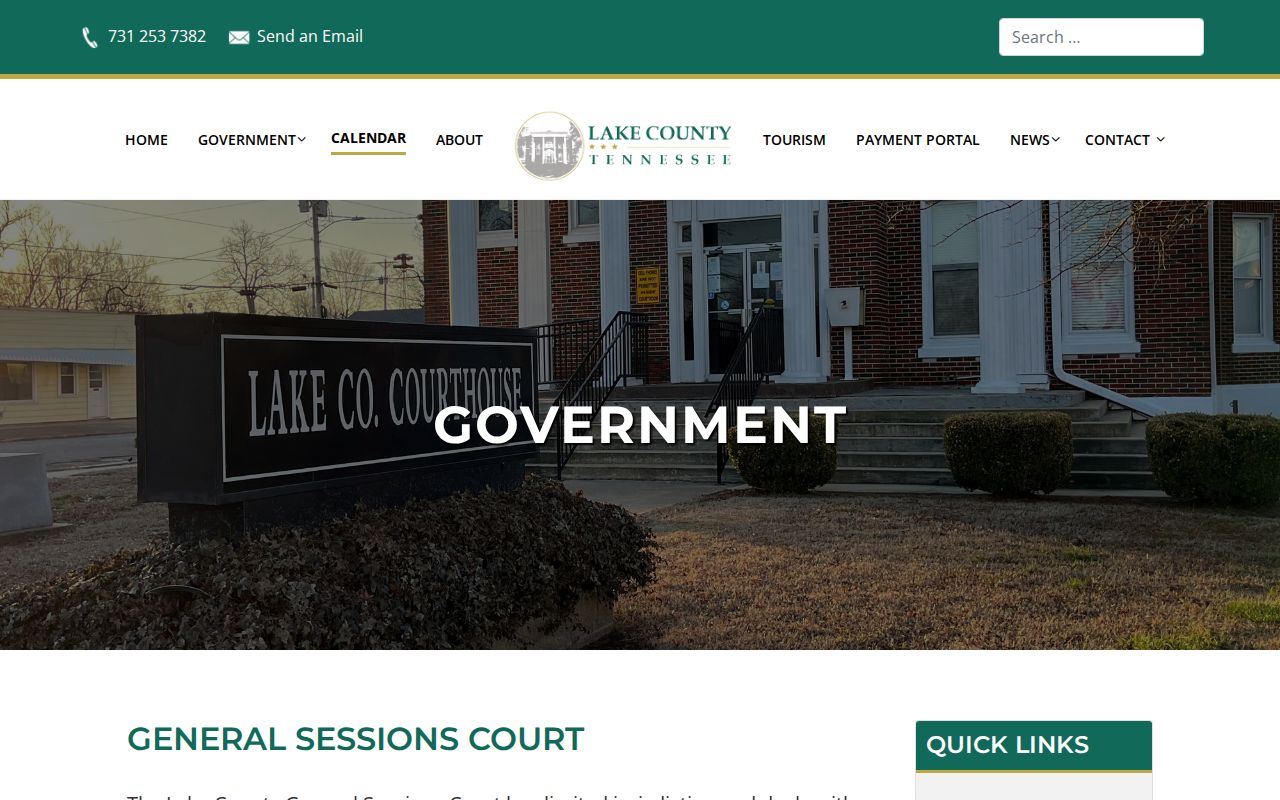
The General Sessions image marks the lower-court starting point, not a complete view of every later felony filing.
Ask the clerk to check both court tracks when the case number is unknown. Give the exact legal name, known name variants, and a narrow filing or incident range. A complaint number and a later indictment number may not look alike. Confirm the court, status, and charge count before requesting documents. Lake County also lists General Sessions and Circuit functions at the same courthouse and uses the same published phone line, which makes the clerk the best place to reconcile a case that moved.
Searching Lake County Case Records
No official public Lake County trial-case portal was found. The complete access route is the clerk by phone, the clerk counter, a focused written copy request, and the Tennessee appellate portal only for appealed matters. The Lake County Courthouse is at 229 Church Street, Tiptonville, TN 38079. Circuit Court Clerk Jessica Avery is listed at Box 11, with (731) 253-7137 and jessica.avery@tncourts.gov. Published county hours are 8:00 a.m. to 4:00 p.m. on weekdays.
- Call the Circuit and General Sessions clerk. Give the exact name, likely filing span, and any known case number.
- Confirm which Lake County court holds the matter and whether it is pending, disposed, archived, confidential, or expunged.
- Ask for the docket sheet, complaint or indictment, judgment on each count, sentencing order, bond entries, and appeal notice as needed.
- Request inspection, a plain copy, or a certified copy. Ask about search, archive, copy, and certification charges because no official local fee list was located.
- If the docket shows an appeal, search the Tennessee appellate system by case number, party, court, or date range.
The Tennessee Appellate Case Search has the following public controls. It covers the Supreme Court, Court of Appeals, and Court of Criminal Appeals, not ordinary Lake County trial dockets.
| Field | Type | Required | Use |
|---|---|---|---|
| Case number | Text | No | Best exact key for an appealed case |
| Party or attorney | Text | No | Name search; check spelling variants |
| Court | Filter | No | Limits results to an appellate court |
| Date range | Date fields | No | Narrows filings or opinions |
| Search or Reset | Buttons | N/A | Runs or clears the query |
Lake County Appeals Search Limits
The appellate portal is easy to mistake for a statewide criminal docket. It is not one. A Lake County misdemeanor that ends in General Sessions or a felony that ends in the trial court may never appear there. A blank appellate result means only that the search found no matching appellate record under those terms. It does not show that no trial case exists.
The manifest capture comes from the official appellate case-search interface.
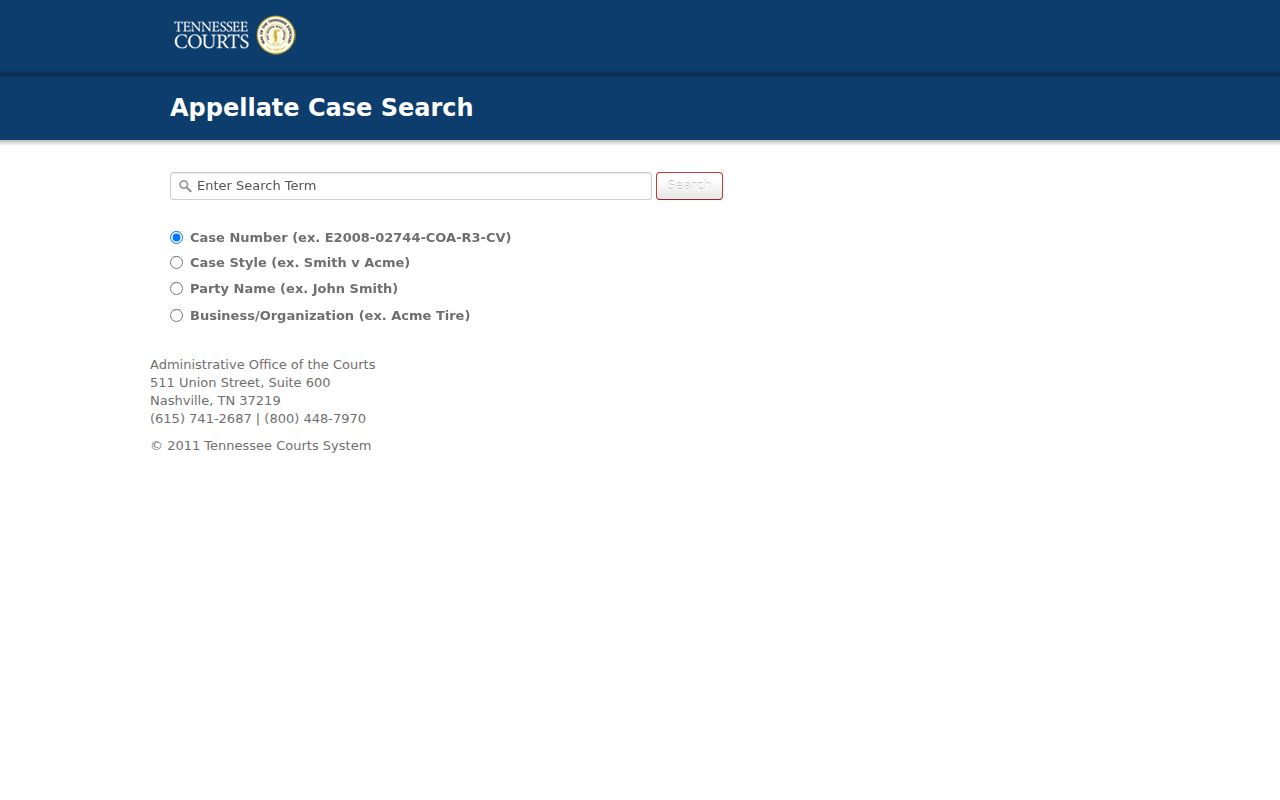
The image shows the statewide appeal layer that should be used only after the Lake County clerk confirms the local case and any appeal.
Names can also produce false joins, especially where initials or common surnames overlap. Match the appellate case number, lower-court county, parties, and filing dates to the clerk's file. Opinions and appellate orders address issues on review. They may not reproduce every exhibit, bond entry, or trial motion. For the complete prosecution record, keep the local docket as the base and add appellate documents only when the case history calls for them.
Inside a Lake County Case File
A Lake County criminal case file is organized around filed allegations and court action, not the jail's intake view. The header identifies the court, case number, filing date, status, division, and judge. Count rows show the offense description, cited statute, felony or misdemeanor class, and result. Docket entries then trace complaints, warrant returns, hearings, grand-jury action, pleas, motions, trials, judgments, sentences, capias entries, probation violations, and appeals.
| Case number and court | The key used to distinguish General Sessions from Circuit or Criminal Court proceedings. |
|---|---|
| Charging document | The complaint, indictment, information, or presentment that states the filed counts. |
| Docket entries | A dated record of filings, hearings, orders, warrants, pleas, and later review. |
| Bond and hearings | Filed release terms, court settings, and related judicial action when public. |
| Disposition and judgment | The result for each count, such as conviction, dismissal, acquittal, or nolle prosequi. |
| Sentence and costs | Confinement, probation, restitution, fines, costs, and other filed conditions. |
Protected identifiers, victim or minor information, expunged content, and sealed material may be removed from public copies. Grand-jury deliberations remain secret even when a returned indictment becomes public. A docket can show that an event happened without giving the full text of a document. Ask whether the underlying paper can be inspected and whether a certified copy is truly required.
Lake County Clerk Record Requests
The Tennessee court clerk directory is a useful check on the local custodian. It should be paired with Lake County's published office information before a visit or mailed request.
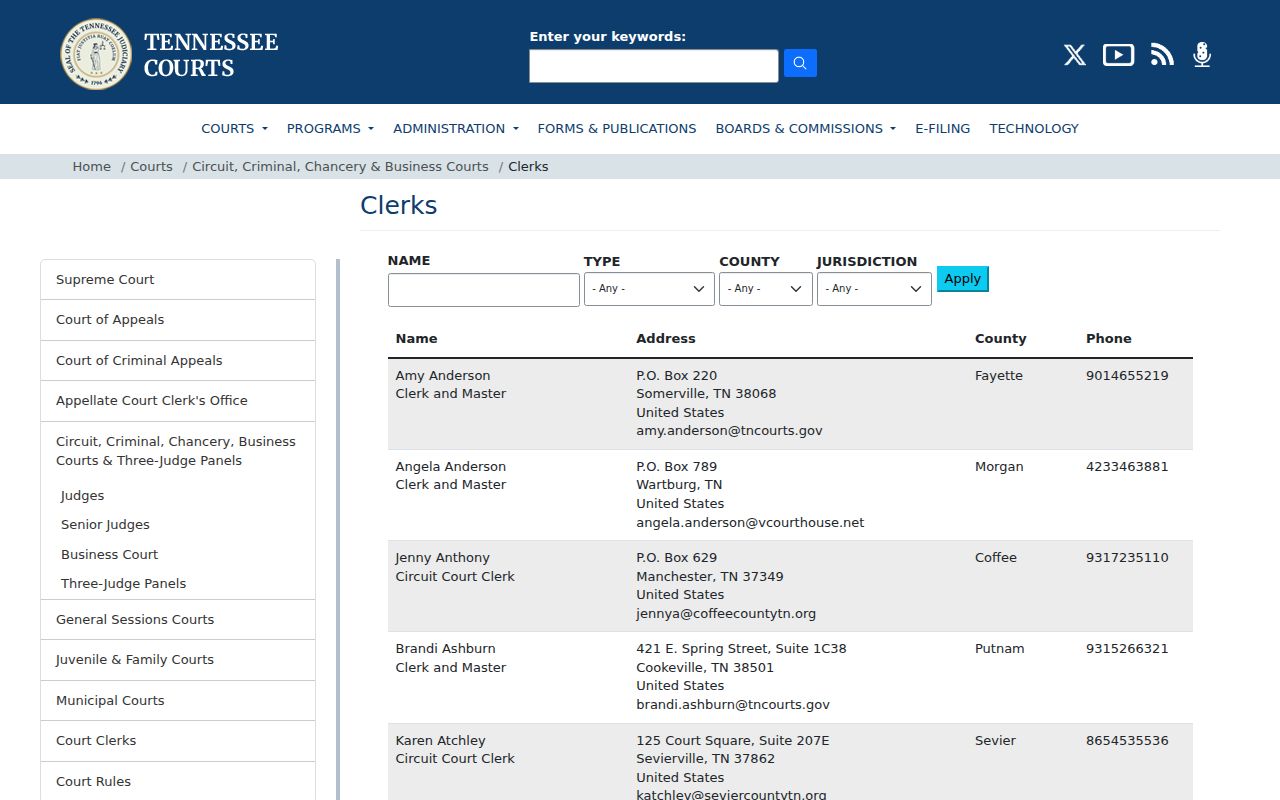
The directory image confirms the clerk channel, while the Lake County office should confirm current access, copies, and any archive procedure.
Lake County Circuit Court Clerk
229 Church Street, Box 11
Tiptonville, TN 38079
(731) 253-7137
Weekdays, 8:00 a.m. to 4:00 p.m.
A written request should be narrow. State the name, case number if known, court, approximate filing date, and exact papers wanted. Ask whether the file is at the counter or in an archive. No official Lake County schedule for copying, certification, archive retrieval, or name searches was found, so request a price and delivery estimate before ordering. Plain copies often serve personal research, while certification adds the clerk's formal attestation for a use that calls for it.
How a Criminal Case Moves
Lake County cases do not all pass through each stage. A citation may begin without a jail booking. A misdemeanor may stay in General Sessions. A felony generally needs grand-jury action before Circuit or Criminal Court adjudicates the indicted counts. Plea talks, motion practice, or dismissal can change the path. The docket is the best source for the route actually taken in one case.
Case flow: Charges Filed › Arraignment › Pretrial › Plea or Trial › Disposition › Sentencing
General Sessions may precede that line with an initial appearance, bond review, complaint, and preliminary hearing. A felony can then be bound over to the 29th Judicial District grand jury. If the grand jury returns a true bill, the indictment may differ from the booking charge. After judgment, a notice of appeal can open a separate record in the Court of Criminal Appeals. Each step should be checked against the date and court shown on the docket.
Lake County Disposition Terms
A single case can end differently on separate counts. Read each disposition rather than relying on the overall status line. A booking allegation is not the filed count, and an indictment is not a finding of guilt. The court's judgment controls the result. Common Lake County docket terms have precise roles:
- Disposition
- The result of a count, such as conviction, dismissal, or acquittal.
- Nolle prosequi
- The prosecutor's formal decision not to continue that charge at that time.
- True bill
- A grand jury's return of an indictment based on probable cause.
- Capias
- A court command to take a person into custody, often tied to nonappearance or an alleged violation.
- Judgment
- The court's formal record of the result and, after conviction, the sentence.
The Tennessee courts' 29th Judicial District page provides local judicial and clerk context.
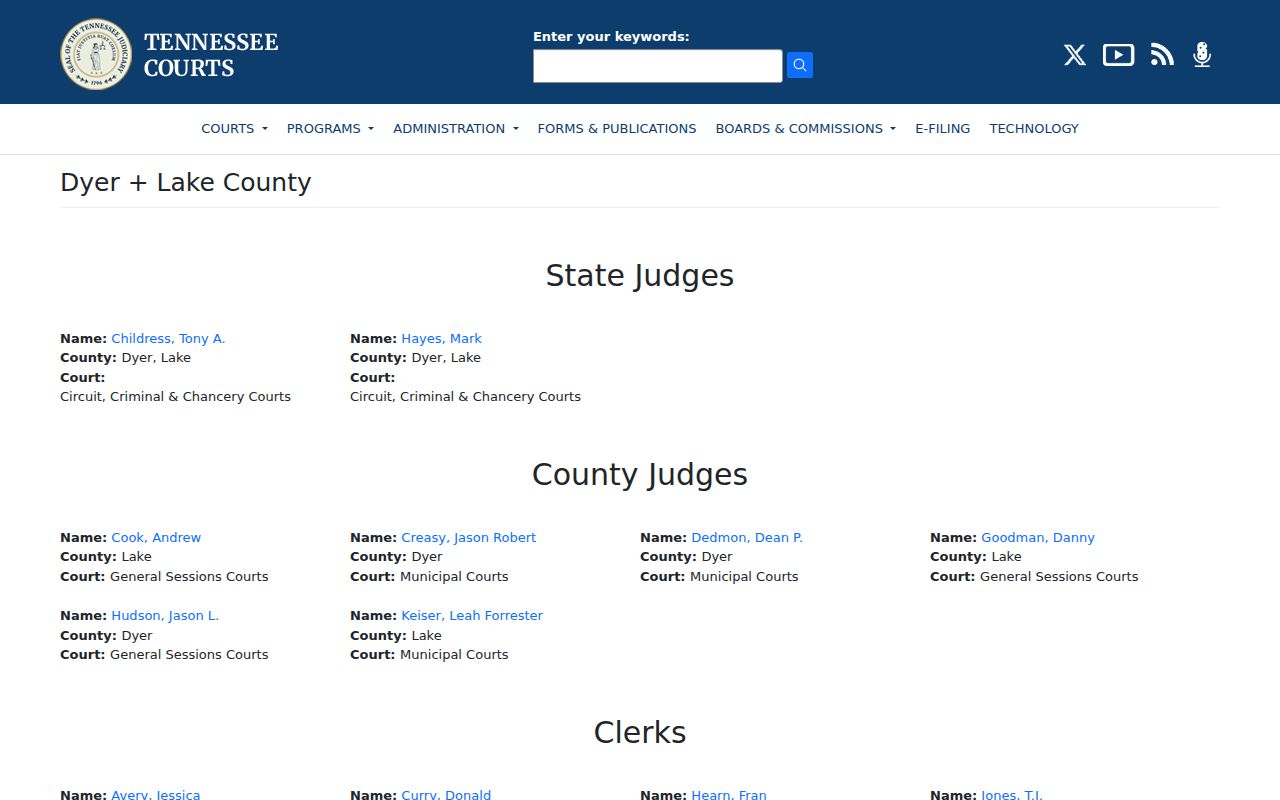
The district image places Lake County within the Dyer and Lake County court structure that handles these criminal proceedings.
Case Record Access & Restrictions
The Tennessee Public Records Act generally presumes access to open government records, while Tennessee Supreme Court Rule 34 governs public access to court records and recognizes exclusions. The clerk may redact a protected field instead of withholding an otherwise open document. Social Security numbers, financial account data, protected victim or minor details, medical information, and juvenile material are not treated like an ordinary public docket entry. Expunged and sealed records also require different handling.
Older matters may be archived rather than closed to the public. A missing electronic reference is not enough to tell the difference. Ask the clerk whether the name was indexed under another form, whether the case predates the present index, and whether a paper search is available. For one's own cleared matter, obtain the full disposition for every count and use the Tennessee court expungement process where eligible.
Lake County Federal Court Files
Federal criminal cases from Lake County belong to the U.S. District Court for the Western District of Tennessee, not the Lake County Circuit Court Clerk. PACER holds the federal docket and filed documents after registration. A county clerk search cannot establish that no federal case exists, and a federal docket does not replace the state trial file.
The manifest image comes from the Western District of Tennessee.
The federal court image identifies the separate system that must be searched when the prosecution was brought under federal law.
Match the caption, case number, division, defendant, and dates before treating federal and state records as the same event. The Federal Bureau of Prisons locator answers a custody question after a federal sentence, not what the federal court decided. In the same way, the broader Lake County arrest lookup can help trace the earlier custody event, but the criminal case file remains the source for filed charges and disposition.